Aesthetic exhibition
Dermatologists lead live demonstrations and provide updates and recommendations on contemporary, cosmetic concepts in the flesh.
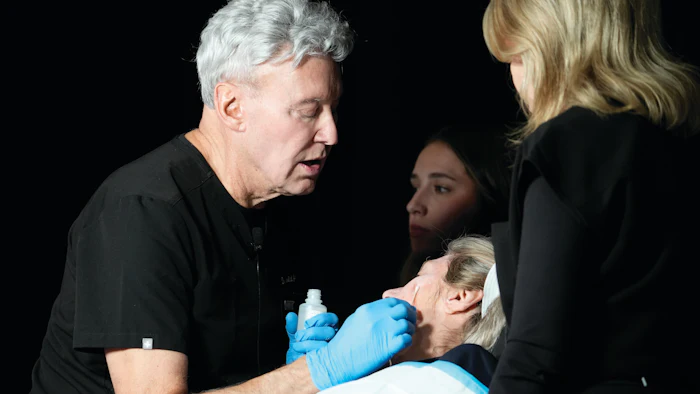
Yesterday, in C005 – Live Demonstration: The State of the Art of Aesthetic Dermatology, expert physicians from around the world shared tips, tricks, and updated techniques for cosmetic procedures. The interactive presentations included therapies such as facial rejuvenation, microneedling, PDO thread lifts, and chemical peels.
During the demonstration, Harold J. Brody, MD, FAAD, and Kimberly J. Butterwick, MD, FAAD, explained the step-by-step process of preparing and performing a chemical peel on a Fitzpatrick type II patient. They also answered questions posed by session director Seth Matarasso, MD, FAAD, and audience members.
As a postoperative regimen, Dr. Brody said the patient should shower at room temperature, putting her face in and out of the water several times for two to three minutes. Then, she should apply a moisturizer or ointment with SPF and can use Aquaphor if experiencing any residual redness.
“Keep it simple, Sherlock,” Dr. Brody said.
In-person follow-up isn’t necessary, but patients can send a picture if they have questions, he said. Healing will occur within five to six days and result in smoother skin.
Marina Landau, MD, IFAAD, is a medical and cosmetic dermatologist based in Israel, who regularly performs chemical peels. Dr. Landau said this method is well-established and clinically relevant for multiple indications, particularly skin enhancement.
“When aesthetic laser technology emerged in the 1980s and 1990s, many physicians predicted that it would entirely replace chemical peels,” she said. “Instead of disappearing, chemical peels have evolved and remained a foundational tool in dermatology.”
“Currently, chemical peels are the only true bioregenerating treatment addressing both epidermis and dermal components,” Dr. Landau said. “Chemical peels offer unique benefits, such as the ability to treat large surface areas that are tailored to specific Fitzpatrick skin types.”
Dr. Landau said chemical peels are also a great option for common dermatologic conditions, including acne, scars, precancerous skin lesions, and pigmentary disorders. The therapy can be supplemented with other treatments, such as fillers, botulinum toxins, and microneedling to boost outcomes.
“Chemical peels remain highly relevant in modern dermatology, acting as a cornerstone for skin rejuvenation, acne management, and pigmentation treatment due to their versatility, cost effectiveness, and ability to produce consistent results,” she said.