Let’s get it started
Two private practice owners provide invaluable insights on how to fly solo.

If you build it, they will come. Unfortunately, building a private dermatology practice isn’t as straightforward as Kevin Costner building a backyard baseball field for legendary ghosts.
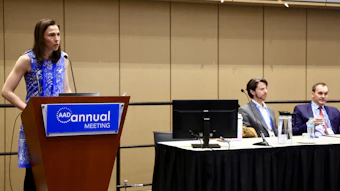
Fortunately, Suzanne McGoey, MD, MsPH, FAAD, and Manasi Kadam Ladrigan, MD, FAAD, led Friday’s session, U025 – Starting a Private Practice 101, to help fill in the gaps and provide valuable personal experience.
At the beginning
Dr. McGoey, founder and owner of McGoey Dermatology in Sheboygan, Wisconsin, said step one is deciding if — and why — you want to be your own employer and the primary decision-maker.
“You already have all the dermatology training to do the clinical medicine, but starting your own practice is an exciting way to be a leader in the business and administrative side,” she said.
Dr. Ladrigan agreed, saying dermatologists shouldn’t start down the path until they answer THE question — or questions.
“Sit down and write a concrete list of what you don’t like about being employed by someone else. Be specific,” said Dr. Ladrigan, who is founder and CEO of Comprehensive Dermatology of Rochester, New York. “Is it a loss of schedule control, pressure around productivity metrics, limited input in staffing decisions, misalignment in values, lack of flexibility?”
Once you have clear, candid answers, you have a blueprint, she said. All the other details and logistics, like financing, credentialing, and finding an office, can be learned and worked out. Dr. Ladrigan also shared her belief that establishing an independent practice can be done at any point of a dermatologist’s career, but that doesn’t mean it is the right decision for everyone.
“Earlier in your career, you may need more upfront capital or a loan. You may feel less certain about the business side, and that is normal. What you often have instead is energy, flexibility, and a long runway to grow,” Dr. Ladrigan said. “Later in your career, you may bring deeper clinical confidence and clearer insight into what truly matters in a practice. You are more likely to know what you value, what you want to avoid, and how you want your days to feel.”
Essential elements
There are specific requirements physicians must complete to set up their new clinic, the panelists said. According to Dr. McGoey, these are:
- Finalizing practice basics, including practice name, legal entity, office space, phone number, digital profile, and EIN.
- Reviewing finance needs and options, then creating a business plan.
- Determining clinical operations, specifically what you’ll need for staffing, equipment, and technology.
- Setting up billing processes, such as payer contracts, credentials, fee schedules, revenue management, and standards for denials, appeals, and collections.
- Developing an organizational structure, which comprises searching for and hiring employees as well as defining office policies and workflows.
- Protecting your business with various insurance and liability policies, regulatory compliances, and personal and employee benefits.
“While every clinic is different, we’re aiming to help dermatologists assess the feasibility of a start-up private practice in the current economic and health system climate,” Dr. McGoey said.
Additional considerations
Although many business factors are obvious or quickly become apparent,
Dr. Ladrigan said seasoned practice owners can provide beneficial resources or tips on what to do and what not to do. She suggested finding a mentor or small network to guide the process and offer support if obstacles arise.
Dr. Ladrigan called attention to several suggestions she has found to be helpful. For example: “Create an SOP for everything,” she said. “If it happens more than once, it should be documented. SOPs reduce decision fatigue, improve onboarding, and protect you.”
Artificial intelligence can be a great tool to help formulate operating procedures, Dr. Ladrigan said. Other tips include:
- Retirement: Start saving early and make it automatic.
- Boundaries: These may evolve depending on life stage but are nonnegotiable. She cautioned physicians not to make exceptions, even small ones, as they can be slippery slopes.
- Office space: Start with what you need; it’s financially better to add more space than take it away or have it sit unused. Exam room doors should open to hide the patient in case nurses or assistants need to enter or exit mid-exam. Try to have natural light with windows or frosted glass.
“Install a generator,” Dr. Ladrigan said. “For roughly the cost of one day of revenue, you can protect procedures, stored medications, and your schedule during outages. It pays for itself in one avoided cancellation day.”
Final words of wisdom
The biggest piece of advice the speakers shared was to be brave and not let fear or risk of mistakes stand in the way.
“When we are younger, someone is always encouraging us to take the next step — move up a grade, try a more advanced class, pursue an unexpected interest, apply to residency. We are pushed forward and supported in stretching ourselves,” Dr. Ladrigan said.
However, the pursuit to start a practice can carry stigma, she said, with ownership reframed as a risky investment instead of a growth opportunity. She and Dr. McGoey encouraged dermatologists to wonder what their own practice would look like and take the leap if it’s right and they’re ready.
“Too often, the fear of imperfection prevents people from getting started at all. Remember that most business mistakes are fixable. There is time to learn, adjust, and improve as you go,” Dr. McGoey said. “You’ve already done the hardest part — becoming a board-certified dermatologist.”