Time to think
Keynote speaker Lisa Bodell laid the groundwork for dermatologists to streamline their practice and carve out more meaningful moments.
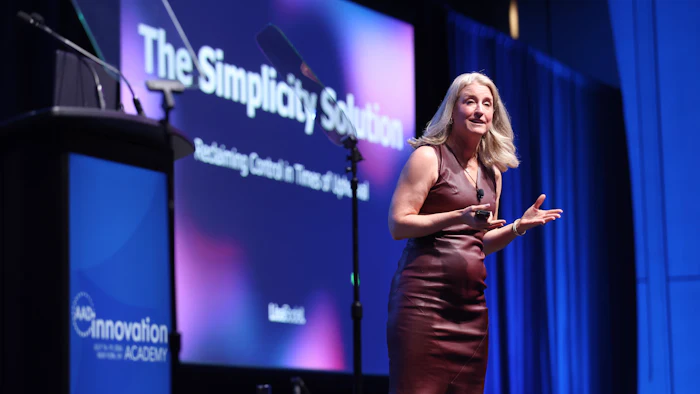
Eliminate the negative, accentuate the positive. This was an overarching message Lisa Bodell provided in the K001 – Keynote at the 2026 AAD Innovation Academy. Bodell is founder and CEO of futurethink, bestselling author of Why Simple Wins and Kill the Company, and a global expert on change and innovation.
Bodell transforms organizations and practices by equipping them with actionable tools and simple techniques to create real change and innovation — and she loves her job!
“There are so many problems that need to be solved; big problems that need disruption, need thinking, need people to put dots together in totally unexpected ways. We need people who aren’t afraid to think far into the future about things that don’t exist yet,” she said. “I want to be the person that helps those dreamers think better.”
Stick to the equation
Bodell uses a three-part framework: eliminate, embed, empower. Though these steps are often applicable to an individual’s personal life, she said the analysis should be completed by work teams to help promote transparency, foster respect, and create accountability.
The first thing people need to do, Bodell said, is eliminate — or subtract — from their workload. For example, you can’t have a thriving garden when it’s full of weeds; the weeds must go. She calls this method “killing stupid rules,” which breaks down to removing tasks or processes that are unnecessary or not adding value. She has seen this strategy work for businesses in all types of industries, including medicine.
“The technique is agnostic; the outputs are not. The most important thing is focusing on your sphere of control,” Bodell said.

“What people come up with when you give them permission to get rid of things typically aren’t rules or regulations — and that’s the aha! There are not a lot of rules that hold people back; it’s mostly habits and processes, things that are cultural norms or assumptions,” she said. “Once we give people a forum or tool to analyze them, they realize they don’t need to be doing it this way.”
But it’s not as simple as identifying the problem areas and eliminating them — weeds grow back. This, Bodell said, is why you need to embed the change. Make it known to others, keep enforcing it, and continue to repeat the analysis, such as during annual planning or training meetings.
Lastly, people need to be empowered to make the change, said Bodell, to say no and subtract things so they have room to be more intentional and meaningful with their time.
“People will work exhaustively hard for the things that matter,” she said. “But at the end of the day, when you’re exhausted, is it good exhausted or bad exhausted?”
Focus on the mission
Bodell said it’s okay to be exhausted at the end of the day if it’s because you achieved something deeply fulfilling or accomplished things that really add value. To illustrate this, Bodell conveyed an essential exercise called “stop it,” where a person or team asks and answers the question, “What if I didn’t?”
In other words, what would you have to stop doing to meet a goal or complete a process? This helps identify the things that are taking up your time, so you can assess whether you’re doing something because it’s required or urgent or if you’re doing something because it’s prototypical, said Bodell. Then, you can distinguish tradeoffs and establish boundaries.
“A lot of the things we do are out of obligation. We feel guilty not doing them, or we feel obligated to do them,” she said. “‘Stop it’ is really freeing because, both personally and professionally, we’ve got to learn that time is a finite resource and we can’t keep giving it away. It’s more valuable than money, but we don’t treat it like that. We keep giving it away, and nobody has the right to take away your time.”
The fundamental equation is subtraction and simplification equals more time and space to innovate, Bodell said — whether that’s the ability to see additional patients or the opportunity to develop novel treatments.
“I don’t know how you can be innovative if you don’t have time to think,” she said. “I want you to get rid of stuff, so you have more space to be innovative. Ideas aren’t the problem — people have great ideas — they just don’t have time to truly form them.”
 Murad Alam, MD, MSCI, MBA, FAAD
“People come to work to do a mission, especially in the medical field. Doctors don’t go to school for meetings, policies, and forms, they go to school to help patients. This allows them to get to those meaningful things.”
The keynote session also included a brief update from AAD President Murad Alam, MD, MSCI, MBA, FAAD.