Carpe diem
Lecturers and researchers demonstrate the importance of instilling innovative evaluation, validation, and application today to create a better tomorrow.
According to leading physician scientists, today’s actions determine tomorrow’s future. This puts dermatologists in the driver’s seat to be responsible for the outcome of their patients and practices.
“The technologies that will reshape this specialty are already entering the room,” said Hensin Tsao, MD, PhD, FAAD, professor of dermatology at Harvard Medical School in Boston. “Many tools that felt futuristic a few years ago are now showing up in real, practical ways. If we wait until they are fully mature to discuss them critically, we end up reacting to the future instead of helping shape it.”
Dr. Tsao was the director of yesterday’s session, F001 – Future of Dermatology: Dermatology Beyond 2040, which traveled into the horizon to examine how innovations will transform dermatology over the next two decades and what the role is for each and every dermatologist.
“The decisions we make now — about validation standards, data quality, regulation, workflow design, reimbursement, and equity — will profoundly influence how these technologies ultimately affect patient care,” Dr. Tsao said.
It’s essential to examine the opportunities that lie ahead, he said, and have the skills to distinguish pie-in-the-sky innovation from practical, essential, transformational innovation.
Hands-on involvement
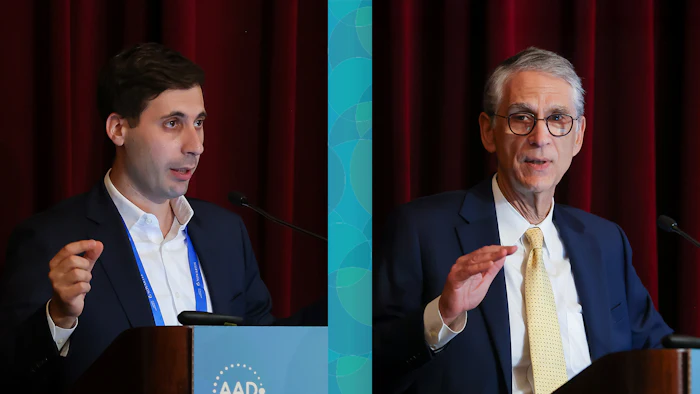
Featured lecturers — Allan C. Halpern, MD, FAAD, and Yevgeniy Semenov, MD, MS, FAAD — laid the groundwork of the session, addressing two of the biggest elements impacting dermatology now and going forward. Dr. Halpern, who is chief of the dermatology service in the department of medicine at Memorial Sloan Kettering Cancer Center in New York City, spoke about emerging imaging devices for skin cancer diagnosis, and Dr. Semenov, who is assistant professor in dermatology at Harvard Medical School in Boston, spoke about the integration of artificial intelligence (AI) across the specialty.

“The urgency is that the future of dermatology is already arriving. Imaging, AI, and digital diagnostics are moving quickly into clinical practice. Dermatologists need to lead this transformation rather than react to it,” Dr. Halpern said.
“Dermatologists have an opportunity to actively shape the development and implementation of AI rather than simply adapt to changes driven by others,” Dr. Semenov said.
A new foundation
In his presentation, Dr. Halpern provided a sweeping overview of the current state of technology and how he envisions it playing out over the next two decades. Historically, diagnosing skin cancer has relied on visual inspection plus dermoscopy or biopsy, when needed. But as personalized medicine becomes more possible, and more expected, he said the full spectrum of diagnostic devices and AI are required.
“These tools remain foundational, but they are no longer sufficient by themselves for the scale, complexity, and equity demands of modern skin cancer diagnosis,” he said. “The next era will be defined by being able to see each lesion in context: patient risk, lesion appearance, prior images, behavior over time, relationship to the patient’s other lesions, and its optical or molecular features.”

- Digital dermoscopy
- 3D total-body photography
- Noninvasive optical microscopy devices
- Spectral and biophysical devices
- AI-supported imaging platforms
“The best imaging devices will help physicians spend less time searching, sorting, and documenting, and more time interpreting, communicating, and making good clinical decisions,” Dr. Halpern said.
In some cases, novel tools may appear advanced or beneficial on the surface but could pose risks in real life, said Dr. Halpern. New imaging devices have potential for significant benefits (e.g., earlier detection, more precise documentation, expanded access) but they can also carry detrimental risks.
“A device can be accurate in a study but impractical in clinic if it takes too long, requires extensive training, creates unclear outputs, is misinterpreted, or is not reimbursed,” he said. “My view is that every imaging device should be evaluated not only for sensitivity and specificity, but also for clinical utility, biopsy impact, patient outcomes, cost, and integration into the actual clinical workflow.”
The bright side
While dermatologists are excited to use AI for image-based diagnosis and lesion classification, Dr. Semenov said its impact extends to other areas as well.
“The potential benefits include improved efficiency, reduced administrative burden, enhanced diagnostic support, better risk stratification, and expanded access to dermatologic expertise,” he said.
These technologies will help optimize workflows and make certain clinical and operational processes more efficient, Dr. Semenov said, such as automating chart review or expediting triage. There are also significant benefits AI can have to patient care.

Dr. Semenov highlighted several types of emerging innovations and examples of what they can accomplish:
- Language models: provide documentation assistance and complex medical record summaries
- Predictive models: identify and stratify at-risk patients
- Multimodal AI systems: incorporate clinical photographs and pathology into electronic health record data
- Agentic AI systems: perform certain administrative and clinical support tasks
Implementing these technologies can allot more time for direct patient care, Dr. Semenov said, but there are important considerations to selecting and adopting them into practice. Awareness and accountability are key.
“Dermatologists should evaluate whether a technology has been rigorously validated, whether its performance generalizes across diverse patient populations, how it integrates into existing workflows, and what safeguards exist for privacy, security, and oversight,” Dr. Semenov said. “Physicians should also understand the limitations of AI systems, including the possibility of bias, inaccuracies, and overreliance on automated recommendations.”
Stress test
So, what ultimately makes a tool or technology a successful candidate for broad implementation?
“It is easy to talk about the future in glowing abstractions,” Dr. Tsao said. “So, we built a session that is visionary and evidence-based at the same time, where emerging technologies are not simply celebrated but are critically examined, and where we ask which innovations are truly transformative, which are overhyped, and which are realistically poised to enter routine practice over the next 10 to 15 years.”

Collectively, the speakers were hopeful but cautious. Most importantly, they stressed, each person is responsible for the future.
“The future of dermatology will not be defined by technologies alone but by how thoughtfully dermatologists integrate these technologies into clinical practice, research, education, and patient care,” Dr. Semenov said. “The decisions we make today will influence how these technologies ultimately serve our patients and our profession.”