Practice management from every angle
Panelists in today’s high-yield session seek to lighten the load for dermatology practice owners who have a lot on their plate.

C001 – Navigating Practice Management in Dermatology: Insights and Innovations
1-4:45 p.m. | Thursday, July 16
Trianon Ballroom
Treating patients is just one element of a dermatology practice. Behind the scenes, you’ll find yourself faced with myriad details that go into running a medical business. These can include coding and insurer updates, barriers to medication access, and incorporating wellness — not just for patients, but for you and those who work on your staff.
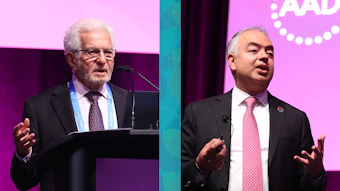
If this sounds like a lot, today’s session, C001 – Navigating Practice Management in Dermatology: Insights and Innovations, has got you covered. Co-director George Han, MD, PhD, FAAD, said the session will feature a series of presentations and roundtable discussions aimed at educating dermatologists in these ever-changing areas of their practice.
“The roundtables will center around dealing with medication access and common practice management challenges for solo and small group practices,” said Dr. Han, who is associate professor of dermatology at the Icahn School of Medicine at Mount Sinai in New York City.
Co-director Alexandra Flamm, MD, FAAD, associate professor of dermatology at NYU Langone Health in New York, said the session will also provide both a refresher in important coding concepts and an update on changes in codes and code descriptors that impact dermatologists.
There have been many recent coding revisions that apply to dermatologists. One area, in particular, that has been hit with CMS changes is surface radiation therapy (SRT), which presenters Alex Miller, MD, FAAD, and Faith McNicholas, the Academy’s senior manager of coding and reimbursement, will address in the session.
“Updates in appropriate coding are always occurring, and it is important that dermatologists are aware of these updates as they can impact their day-to-day practice in often significant ways,” Dr. Flamm said.
Another critical area of practice management, Dr. Flamm said, is learning how to deal with barriers to medication access that can arise in the form of prior authorizations and step therapy requirements from insurance companies.
“It is important to understand these insurer requirements and the tools that can be utilized to ensure prompt responses to insurers so patients can access their medications quickly and safely,” she said.
The comprehensive session will also include presentations on pertinent practice management topics, such as legislative/regulatory updates, teledermatology, and quality improvement.
Dr. Flamm said the Academy’s Practice Management Center can be an invaluable resource for physicians and their staff across a multitude of areas, like prior authorizations, coding, payer policies, MIPS reporting, and more. The Academy provides these tools to help reduce administrative burdens, improve workflows, and ease stress.
Even with those tools, physician burnout can still be an issue. Session presenter Brad Glick, DO, MPH, FAAD, a dermatologic surgeon with Skin and Cancer Associates in Margate, Florida, said physician and staff well-being are directly linked to quality of care, patient satisfaction, retention, and safety.
“Dermatology practices should implement sustainable scheduling models, team-based care, administrative burden reduction, and proactive mental health resources,” he said. “A healthy workforce is essential to delivering exceptional patient outcomes and maintaining long-term practice viability.”